
Blog cold plunge
A Beginner Cold Plunge Protocol: 11 Minutes a Week
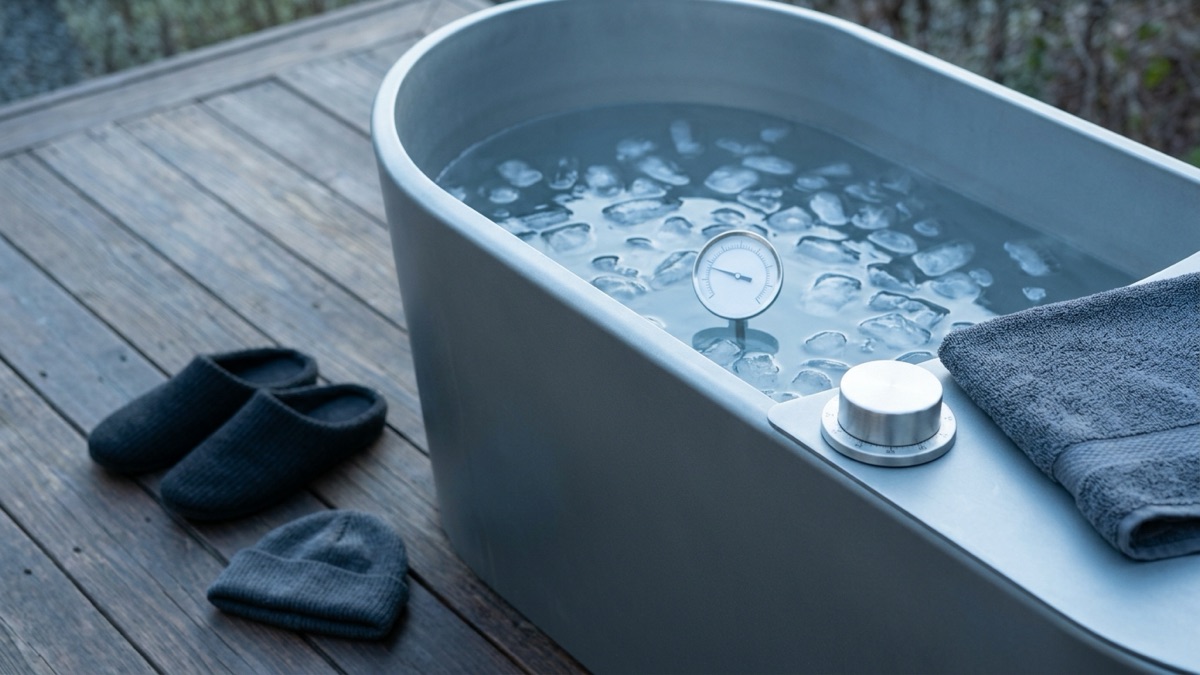
Every cold plunge protocol on the internet traces back to one number, and almost none of them say where it came from. This one does. It is a four-week plan that builds to 11 minutes of cold a week across short sessions, with the study behind the number, the popular protocols named as popular protocols, and the safety rules on every week.
Quick answer
Plunge two to four times a week in water between 50 and 59 F, one to two minutes at first, building over four weeks to about 11 minutes of cold a week in total. That total is the weekly average of 8 winter swimmers in a 2021 study, not a prescription. Never alone, never after alcohol, and out when you feel lightheaded or numb.
Key takeaways
- The 11 minutes a week comes from the participant table of the 2021 Soberg study: 8 young winter-swimming men, 2 to 3 sessions a week, about 1.4 minutes per dip.
- A popular newsletter turned that into "11 minutes per week total, 2 to 4 sessions of 1 to 5 minutes", which is a sensible shape and still a popular protocol.
- Build by sessions first, then minutes, and never past five minutes in water at or below 59 F, per Cleveland Clinic.
- "End with cold" means letting yourself rewarm by moving rather than with a hot shower. The study did not test it; it is a preference, not a finding.
- If you lift, plunge before training or on other days: a 12-week trial found cold water after strength sessions blunted gains.
Where does the 11-minute protocol come from?
From a Danish brown fat study, not from a trial of protocols. In 2021, Soberg and colleagues published a paper in Cell Reports Medicine on 8 young, healthy men who had practiced winter swimming at least 2 to 3 times a week, compared with 8 similar men who had not. The point of the study was to measure brown fat, cold-induced heat production and body temperature. The participant table describes what the swimmers were already doing: about 2.6 dips per visit of about 1.4 minutes each, two sauna visits of about 11 minutes, and in total 11 minutes immersed in cold water and 57 minutes in sauna heat per week.
The study found that the swimmers produced more heat in response to cold, ran a lower core temperature and showed no brown fat glucose uptake at rest, and its authors suggest they were acclimated to both cold and heat. They also wrote that the small sample "provides a risk for type 1 and type 2 errors", that they could not say whether winter swimming caused the differences, and that people with a certain thermal profile might simply be more likely to take up the hobby. Eight men, no women, one city.
A widely read Huberman Lab newsletter later recommended "11 minutes per week TOTAL" of deliberate cold exposure, "NOT per session, but rather, 2-4 sessions lasting 1-5 mins each distributed across the week", and described it as a minimum. That recommendation is where the protocol below gets its shape. We present it as what it is: a popular protocol built on a small observational table. It is a reasonable amount of cold for a healthy adult to aim at. It is not a dose with a trial behind it.
The four-week beginner cold plunge protocol
Water between 50 and 59 F (10 to 15 C), which is Cleveland Clinic's beginner range, measured with a thermometer right before you get in. Start at the warm end. Every session: timer set before you enter, long slow exhales through the first minute, out when the timer rings or sooner, then dry off, dress in layers and move around to rewarm.
| Week | Sessions | Minutes per session | Weekly cold total | What you are learning |
|---|---|---|---|---|
| 1 | 2 | 1 to 1.5 | 2 to 3 | Breathing through the first minute; getting in and out safely |
| 2 | 3 | 1.5 to 2 | 4.5 to 6 | The first minute gets calmer; rewarming by moving |
| 3 | 3 | 2 to 3 | 6 to 9 | Holding a steady exhale; noticing numb hands early |
| 4 | 3 to 4 | 2.5 to 3 | 7.5 to 12 | Arriving at about 11 minutes; deciding whether to stay here |
Week 4 is where the protocol ends and your routine begins. There is no week 5 with more minutes: the reference total is reached, and the thing to grow from here is consistency. Cleveland Clinic's advice to beginners is once or twice a week to start and adding days as your body adapts, which is exactly the shape of weeks 1 to 4.
Try it
The free cold plunge time calculator gives you the session length for your actual water temperature and experience, and shows how many sessions reach the 11-minute reference.
Why sessions before minutes?
Because the thing that changes with practice is the cold shock response, not your body's rate of cooling. The 2022 narrative review by Espeland and colleagues reports that thermal sensation and comfort "become habituated after a few short-lasting whole-body immersions in cold water", and that the change is temporary, lasting some weeks after you stop. Repeated short exposures are what train the first minute. A single long session trains nothing extra and cools you more.
That is also why the Soberg swimmers' 1.4 minutes per dip is the most useful number in their table. People who had done this for years were not sitting in the sea for ten minutes. They went in, stayed under two minutes, came out, warmed up, and went back. Three short sessions a week will get you further than one heroic one, and the cold plunge every day guide explains why daily is not the next step either.
What does "end with cold" actually mean?
The newsletter's version is practical: to get more out of a session, "force your body to reheat on its own", which means no hot shower straight after, no towel at first, no huddling, and a walk instead. The idea is that shivering and rewarming are part of the stimulus. It has a popular name, the Soberg principle, after the study, but it is worth being precise about what the study showed. Its swimmers alternated sea dips with sauna sessions; whether they ended on cold is not reported, and the paper did not test the order. So "end with cold" is a reasonable way to finish a session, especially in the morning, and nothing more than that.
Two groups should end warm instead. People who struggle to rewarm, who are small and lean, or older, can end up shivering for an hour after a plunge, and ending in a sauna or warm room solves it. And anyone doing a session in the evening will sleep better ending warm. The end on hot or cold guide goes through both.
Tip
Rewarm by moving. Get dry, put on layers including a hat, and walk for five minutes. Save the hot shower for later, and skip it entirely if you feel faint, because warming the skin fast can drop your blood pressure.
Where does the protocol bend for your life?
If you lift weights, move the cold away from training. In a 12-week trial, Roberts and colleagues had men sit in 10 C water for 10 minutes after each strength session, and they gained less strength and less muscle than men who cycled gently instead. Cleveland Clinic gives the same warning in plain terms. Plunge before you lift, on non-lifting days, or several hours after. The cold plunge after a workout guide covers the timing for runners and lifters separately.
If your goal is mood and alertness, the morning slot works for most people and the sessions can stay at the short end; the response arrives in the first minute. If your goal is recovery after hard endurance sessions, the research used 10 to 15 C for 10 to 15 minutes in trained athletes, and this protocol deliberately does not take you there. If your water is colder than 50 F, shorten every number in the table: the National Center for Cold Water Safety lists water below 50 F as the band of maximum cold shock for people not used to it, so the first weeks belong in the 50s.

Heads up
Cold water is a real stressor. The first minute brings gasping, fast breathing and a jump in heart rate and blood pressure, and the cold shock response is at its strongest before you are used to it. Never plunge alone, never after alcohol, never hold your breath or hyperventilate in or before the water, and get out when you feel lightheaded, numb or confused. The CDC's warning signs of hypothermia are shivering, exhaustion, confusion, fumbling hands, memory loss, slurred speech and drowsiness. If you have a heart condition, high blood pressure or take medication for it, are pregnant, or have Raynaud's, peripheral neuropathy or poor circulation, talk to your doctor before you start this protocol.
What to log each session
Four things: the water temperature, the minutes, how the first minute felt on a 1 to 5 scale, and how you rewarmed. After four weeks you will be able to see the only progress that matters, which is a calmer first minute at the same temperature, not a lower temperature or a longer time. The how to log cold plunge sessions guide has a template, and the PlungeLog app, coming to Android first, will time the session and log those four things with one tap.
The takeaway
Two sessions of a minute or so in your first week, three sessions of two to three minutes by your fourth, water in the 50s, a timer set before you get in, and rewarming by walking. That gets you to the 11 minutes a week that 8 Danish winter swimmers averaged, which is a good amount of cold for a healthy adult and nothing more exact than that. Keep the rules that do not change: never alone, never after alcohol, never a breath-hold, and out the moment something feels wrong.
PlungeLog guides are general information built on the published research and safety guidance listed below. They are not medical advice and do not diagnose or treat anything. Cold water and heat stress the heart and can cause cold shock, hypothermia, fainting and dehydration. Never plunge alone or after alcohol, and talk to your doctor before you start if you have a heart condition, high blood pressure, are pregnant, or have Raynaud's or poor circulation.
Questions people ask
What is the Soberg principle?
A popular name for ending a cold session on cold and letting your body rewarm on its own, inspired by the 2021 Soberg study of winter swimmers. The study itself describes dips alternated with sauna; it does not test ending on cold. Treat it as a popular protocol, not a finding.
Should I cold plunge every day as a beginner?
No. Cleveland Clinic suggests once or twice a week to start and adding days as you adapt. The 11 minutes a week reference was spread over 2 to 3 sessions, and rest days are part of the protocol.
What temperature should the protocol use?
The beginner range of 50 to 59 F (10 to 15 C), per Cleveland Clinic. Start at the warm end and shorten the session rather than lower the temperature if it feels like too much.
What if I lift weights?
Plunge before you lift, or on non-lifting days. A 12-week trial found 10 minutes at 10 C right after strength sessions blunted strength and muscle gains compared with easy cycling.
What if I miss a week?
Go back one week in the protocol rather than picking up where you left off. The habituation that makes cold feel manageable fades over some weeks without sessions, according to the Espeland review.
Where these facts come from
- Soberg et al. 2021, Cell Reports Medicine: winter-swimming men: pmc.ncbi.nlm.nih.gov/articles/PMC8561167/
- Huberman Lab newsletter: the science and use of cold exposure (a popular protocol): www.hubermanlab.com/newsletter/the-science-and-use-of-cold-exposure-for-health-a
- Cleveland Clinic: Are 'cold plunge' ice baths good for you?: health.clevelandclinic.org/what-to-know-about-cold-plunges
- Espeland, de Weerd and Mercer 2022, International Journal of Circumpolar Health: health effects of voluntary exposure to cold water: pmc.ncbi.nlm.nih.gov/articles/PMC9518606/
- Roberts et al. 2015, Journal of Physiology: post-exercise cold water immersion and strength training adaptations: pmc.ncbi.nlm.nih.gov/articles/PMC4594298/
- National Center for Cold Water Safety: water temperature safety guide: www.coldwatersafety.org/water-temperature-safety-guide
- CDC: preventing hypothermia: www.cdc.gov/winter-weather/prevention/index.html
Read next
contrast therapy
Sauna and Cold Plunge: The Right Order and a Weekly Routine