Blog cold plunge
How Long to Cold Plunge: Minutes by Water Temperature
The timer is the most important piece of equipment you own, and the number you set it to is the question everyone asks in the first week. Two minutes or five? Ten, like the athletes? The answer depends on the water temperature and on how long you have been doing this, and it is shorter than most videos suggest.
Quick answer
Start with a minute or two in water between 50 and 59 F, and treat five minutes as the ceiling, which is Cleveland Clinic's advice. Colder water means a shorter session. The 10 to 15 minute sessions in research were trained athletes in supervised studies. Set the timer before you get in, and get out when it rings.
Key takeaways
- Beginners: a minute or two at 50 to 59 F, per Cleveland Clinic, and never more than five minutes.
- The winter swimmers in the 2021 Soberg study averaged about 1.4 minutes per dip, 2 to 3 sessions a week, and about 11 minutes of cold water a week in total.
- The 10 to 15 minute immersions in recovery studies were trained athletes at 10 to 15 C; the same meta-analysis found shorter times linked to larger effects on some outcomes.
- Experience lowers the cold shock response, not the rate your hands and feet lose function, so add sessions before you add minutes.
- Harvard Health sets a hard maximum of 15 minutes for an ice bath, with someone nearby. Nothing on this site suggests getting anywhere near it.
How long should a first cold plunge be?
Short. Cleveland Clinic's sports medicine physician Dominic King suggests beginners "aim for a minute or two" in water between 50 and 59 F (10 to 15 C), and says a session should never exceed five minutes. His advice is to start slow and see what your body tolerates before staying in longer.
There is a physiological reason the first session should be short, beyond caution. Cold water triggers a cold shock response the moment it hits a large area of your skin: an involuntary gasp, fast breathing, and a spike in heart rate and blood pressure. The National Weather Service notes this phase lasts "the first 2-3 minutes or more". A first plunge that ends at 60 to 90 seconds has done the useful part and skipped the part where you are cooling while still fighting your breathing.
Tip
Set the timer before you get in and put it where you can see it without turning your head. Deciding to get out is harder than it sounds once your thinking slows, and a timer takes the decision away from the part of your brain the cold is working on.
What do the minutes look like by water temperature?
Every ten degrees of water changes the sensible session. These are planning numbers, built from the Cleveland Clinic ceiling and the temperature bands in the National Center for Cold Water Safety guide, not results from a study. The free calculator uses the same table.
| Water | First week | Regular (a few weeks in) | Experienced (months) |
|---|---|---|---|
| Below 40 F | Not yet | Up to about 1 minute | Up to about 2 minutes |
| 40 to 49 F | About 1 minute | 1 to 2 minutes | Up to 3 minutes |
| 50 to 59 F | 1 to 2 minutes | 2 to 3 minutes | Up to 5 minutes |
| 60 to 69 F | 2 to 3 minutes | 4 to 6 minutes | Up to 10 minutes |
Two things stand out. The ceiling never rises above five minutes for water at or below 59 F, whatever your experience. And the 60s, which many people dismiss as not cold enough, give you the longest sessions, because the water cools you slowly enough that a few minutes does real work without the maximum cold shock. Harvard Health's warning that hypothermia can begin within minutes in water below 65 F is why even those sessions keep a timer.
Try it
The free cold plunge time calculator takes your water temperature, experience and goal and gives you a session length, the warning thresholds for that temperature, and a weekly target, with the math shown.
Two minutes or five: what changes between them?
Mostly risk, not benefit. The alerting response, the surge of adrenaline and the deep breaths that people come for all happen in the first minute or two. After that, what accumulates is cooling. The National Center for Cold Water Safety describes the next stage, incapacitation, in blunt terms: in very cold water "you can lose the use of your hands in 60 seconds, and use of your arms in minutes". In a 55 F tub that happens far more slowly than in a 35 F lake, but the direction is the same, and numb hands are what make climbing out of a tub awkward.
There is a useful reference point for how much time experienced people actually spend in the water. The 2021 Cell Reports Medicine study by Soberg and colleagues followed 8 young Danish winter swimmers who swam 2 to 3 times a week in sea water that runs between 9 C and 1 C in season. Their participant table lists about 1.4 minutes per immersion, 2.6 immersions per visit, and 11 minutes of cold water per week in total. These are people who had done this for years, and they stayed in for less than two minutes at a time.
So the honest answer to "two or five" is that five is a ceiling for the 50s, not a target, and that most of what you want happens by two.
Why do the research studies use 10 to 15 minutes?
Because they were studying something different: next-day recovery in trained athletes, under supervision, at a measured temperature. The 2022 Sports Medicine meta-analysis by Moore and colleagues pooled 52 studies, most of which used 10 to 15 C water for about 10 to 15 minutes. It found that cold water immersion reduced soreness and improved perceived recovery 24 hours after high-intensity exercise, with smaller effects after eccentric strength work.
Two details from that review matter for anyone copying the protocol at home. First, "shorter time and lower temperatures were related to the largest beneficial effects" for some outcomes, so 15 minutes was not better than 10. Second, those participants were physically active, often competitive, and were not alone in a backyard tub. A 10-minute session at 10 C is a research dose, not a beginner dose.
There is also a reason to be careful about long cold sessions if you lift. In a 12-week trial by Roberts and colleagues, men who sat in 10 C water for 10 minutes after each strength session gained less strength and less muscle than men who did 10 minutes of easy cycling instead. The lesson is about timing as much as duration: plunge before you lift or wait several hours, as the cold plunge and muscle growth guide explains.
How long should an ice bath be?
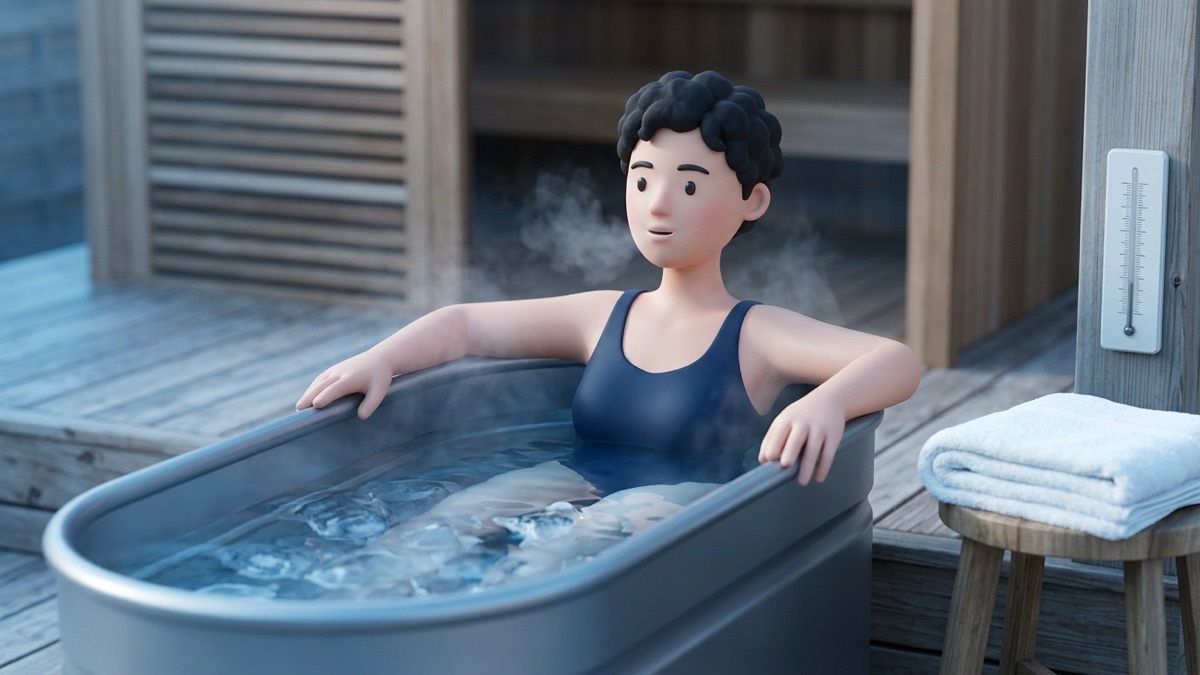
The same as a cold plunge at the same temperature, which is the whole point of measuring. Harvard Health describes most ice baths as 50 to 60 F and sets two rules that apply to any tub: stay in no longer than 15 minutes, and never go in without someone nearby. Fifteen is a hard maximum for supervised athletes, not a goal, and on this site nothing goes past five for water in the 50s.
What makes ice baths different is drift. A tub of tap water and bagged ice starts colder than you planned and warms as you sit in it, so a session that started at 48 F may end at 54 F. Check the thermometer before you get in, and plan the session for the starting temperature. The how long should an ice bath be guide covers the ice-specific details.
How long is too long?
Any session where you stop being able to tell. The CDC's warning signs of hypothermia are shivering, exhaustion, confusion, fumbling hands, memory loss, slurred speech and drowsiness, and a body temperature below 95 F is an emergency. You will not get a thermometer reading in the tub, so use the signs: shivering you cannot control, hands that will not grip, thinking that goes slow, or shivering that stops while you still feel cold. Any of those means out, now, and the Cold Water Safety stages page adds a less obvious one: a badly chilled person can collapse when suddenly removed from the water, so stand up slowly and sit down if you feel faint.
Heads up
Cold water is a real stressor. The first minute brings gasping, fast breathing and a jump in heart rate and blood pressure, and the National Center for Cold Water Safety notes that you can drown in that stage before hypothermia is ever a factor. Never plunge alone, never after alcohol, and never hold your breath or hyperventilate in or before the water. Get out when you feel lightheaded, numb or confused. If you have a heart condition, high blood pressure or take medication for it, are pregnant, or have Raynaud's, peripheral neuropathy or poor circulation, talk to your doctor before you start.
How should the minutes grow over the first month?
Slowly, and by sessions first. Cleveland Clinic suggests once or twice a week to start, adding days as your body adapts. A reasonable first month is one to two minutes twice a week, then three times, then two to three minutes, which lands you near the 11 minutes a week the Soberg swimmers logged without ever going past the ceiling. The beginner cold plunge protocol lays that out week by week, and the cold plunge temperature guide explains why the water, not the clock, should be the thing you adjust.
The PlungeLog app, coming to Android first, will run the timer, log the minutes and water temperature, and show your week against that 11-minute reference.
The takeaway
A minute or two to start, five as the ceiling for water in the 50s, and shorter as the water gets colder. The athletes' 10 to 15 minutes were supervised research sessions, and even there, shorter was not worse. Add sessions before you add minutes, set the timer before you get in, and let it make the decision for you.
PlungeLog guides are general information built on the published research and safety guidance listed below. They are not medical advice and do not diagnose or treat anything. Cold water and heat stress the heart and can cause cold shock, hypothermia, fainting and dehydration. Never plunge alone or after alcohol, and talk to your doctor before you start if you have a heart condition, high blood pressure, are pregnant, or have Raynaud's or poor circulation.
Questions people ask
How long should a beginner stay in a cold plunge?
A minute or two in water between 50 and 59 F, according to Cleveland Clinic, and never more than five minutes. Set a timer before you get in and get out when it rings, or sooner if anything feels wrong.
Is a 2 minute cold plunge enough?
For most goals, yes. The cold shock response and the alerting effect arrive in the first minute or two, and the winter swimmers in the 2021 Soberg study averaged about 1.4 minutes per dip. Longer sessions are for trained athletes in recovery studies, not for home tubs.
How long is too long in an ice bath?
Cleveland Clinic sets five minutes as the ceiling for a plunge, and Harvard Health sets a hard maximum of 15 minutes for an ice bath with someone nearby. In practice, get out at the first sign of numb hands, uncontrolled shivering, confusion or lightheadedness.
Why did the athlete studies stay in for 10 to 15 minutes?
Those were supervised trials in trained athletes, usually at 10 to 15 C, measuring next-day recovery. The 2022 Moore meta-analysis also found that shorter times were linked to larger effects on some outcomes, so longer was not better even there.
Should I cold plunge for longer as I get used to it?
A little. Experience lowers the cold shock response, not the rate your muscles and nerves cool. Add sessions before you add minutes, and never go past the five-minute ceiling for water at or below 59 F.
Where these facts come from
- Cleveland Clinic: Are 'cold plunge' ice baths good for you?: health.clevelandclinic.org/what-to-know-about-cold-plunges
- Harvard Health: Can ice baths improve your health?: www.health.harvard.edu/healthy-aging-and-longevity/can-ice-baths-improve-your-he
- Moore et al. 2022, Sports Medicine: cold-water immersion after strenuous exercise, meta-analysis: pmc.ncbi.nlm.nih.gov/articles/PMC9213381/
- Roberts et al. 2015, Journal of Physiology: post-exercise cold water immersion and strength training adaptations: pmc.ncbi.nlm.nih.gov/articles/PMC4594298/
- Soberg et al. 2021, Cell Reports Medicine: winter-swimming men: pmc.ncbi.nlm.nih.gov/articles/PMC8561167/
- National Center for Cold Water Safety: stages of cold water immersion: www.coldwatersafety.org/cold-water
- National Weather Service: cold water hazards and safety: www.weather.gov/safety/coldwater
- CDC: preventing hypothermia: www.cdc.gov/winter-weather/prevention/index.html
Read next
contrast therapy
Sauna and Cold Plunge: The Right Order and a Weekly Routine